
TREE CARE · OʻAHU
Pruning
Selective care that supports structure, long-term health, and your tree’s natural form.
01 / OUR SPECIALTY
Pruning with purpose
Proper pruning is knowing what to leave, not just what to remove.
We take pride in careful, detailed pruning. Our trained crew puts in the extra time and effort to use pole pruners, pole saws, handsaws, and pruning shears whenever possible, keeping chainsaw use to a minimum. We focus on preserving each tree’s natural structure, limiting unnecessary wounds, and avoiding excessive crown removal and improper heading cuts. That attention to detail is what sets our pruning apart.
Structural pruning
Whether it’s removing a codominant stem from a juvenile tree or removing structural defects in mature trees, structural pruning is all about making sure the tree is structurally sound.
End-weight thinning & reduction
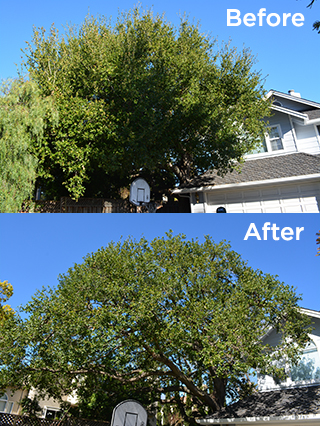
Proper pruning works from the outside of the canopy inward, reducing weight at branch ends and allowing air to flow through the canopy. We choose our cuts carefully to avoid creating wounds the tree may struggle to compartmentalize.
Deadwood removal
Remove dead branches with careful attention to proper cuts.
Vista & view pruning
Pruning to open up views while respecting the tree’s natural structure and form.
Clearance pruning
Create appropriate clearance around houses, gutters, and property lines.
Restoration pruning
Address previous pruning damage, broken limbs, and structural concerns with a plan for improvement. Some restoration work can be addressed in one visit. Other trees benefit from a plan over several years, with realistic goals for healthier, more natural growth.
OUR PRUNING STANDARDS
Care that respects the tree.
Our approach to shade trees, ornamentals and fruiting trees draws on years of field experience. We prune to support tree health and safety while preserving natural structure and appearance.
The type of pruning depends on the tree and the purpose of the work. Our four pruning categories are outlined below.
Natural aesthetic pruning
For trees where appearance and natural form are a priority. We remove dead, dying, diseased, decayed, interfering and weak branches, with selective thinning to reduce wind resistance while preserving the tree's character. This includes appropriate work on the main trunk and within the canopy.
Selective end-weight pruning
For trees where structural integrity and health take priority over appearance. Work includes removing dead, dying, diseased, decaying, interfering, obstructing and weak branches, together with selective thinning to lessen wind resistance.
An occasional undesirable branch up to one inch in diameter may remain within the leafy canopy where removal is not practical.
Hazard pruning
For situations where safety is the primary concern. This work focuses on removing dead, diseased, decayed and visibly weak branches two inches in diameter or larger.
Crown reduction
For reducing the crown, canopy or individual limbs where there is a specific need. A parent limb or dominant leader is cut back at its attachment to a lateral branch.
Crown reduction may be appropriate when branches interfere with utility lines, following significant crown dieback, for specific topiary or dwarfing objectives, or to address storm damage and previous improper pruning.
Crown reduction is distinct from topping, which is generally considered an unacceptable tree-care practice.
During selective end-weight and hazard pruning, visible girdling roots, signs of disease or decay, fungal fruiting bodies, splits, cracks and other structural weaknesses are reported to the supervisor or property owner, with corrective measures recommended.
The practices behind our work
Clean cuts and careful branch removal
Pruning cuts are made close to the trunk or parent limb without cutting into the branch collar or leaving a protruding stub. Bark surrounding the cut should remain firmly attached, and tools are kept sharp for clean cuts.
Branches too large to support safely with one hand are pre-cut using the three-cut method to prevent bark tearing. Ropes and appropriate rigging are used when needed to lower branches and wood safely.
Protecting bark and living tissue
Equipment that damages bark or cambium is not used on live trees. Climbing spurs or irons are not used for this pruning work.
Wounds and existing injuries
Wound dressings, pruning paints and cavity filling are generally avoided. Research has not shown wound dressings or pruning paints to prevent or reduce decay, and some applications may make decay worse.
If a wound is painted for a special purpose, only a thin coating of non-toxic material that is safe for living tree tissue is applied to the exposed wood.
Existing injuries are inspected. Where callus growth is incomplete and loose or damaged bark is present, bark tracing may be used without cutting into the sapwood. Wound margins are left smooth and rounded.
Timing and cleanup
For trees susceptible to infectious disease, pruning is scheduled to avoid periods when relevant pathogens or insect carriers are most active and to minimize attraction of harmful insects.
All cut branches and debris are removed from the canopy when pruning is complete.
Let’s talk about your trees.
Tell us about your property. We’ll help you plan the next step.